
From CO₂ to stone: Australia’s distinctive geology demands a fundamentally different approach.
- CSIRO researchers are working on carbon storage that permanently converts CO₂ into solid minerals underground, eliminating the risk of gas leakage.
- Australia’s distinctive geology offers real potential for this technology, but demands a fundamentally different approach to those that have worked elsewhere.
- By building the site-specific evidence base, CSIRO is moving in-situ carbon mineralisation from laboratory proof-of-concept towards Australian field deployment.
Conventional carbon storage injects CO₂ deep underground and relies on pressure and geology to keep it there. The problem is that physical containment has a fundamental limitation: injected CO₂ whether a gas or a supercritical fluid, is naturally buoyant. If there is a leak, or a seal fails, it can migrate upward and escape containment.
Dr Lionel Esteban, Principal Petrophysicist with CSIRO Energy’s Rock Properties team, is working on an entirely different approach – in-situ carbon mineralisation. The process involves dissolving CO₂ in water, injecting the solution into reactive volcanic rocks, and letting geochemistry do the rest. The CO₂ reacts with the rock to form stable solid carbonate minerals. It doesn’t just get stored; it turns to stone.
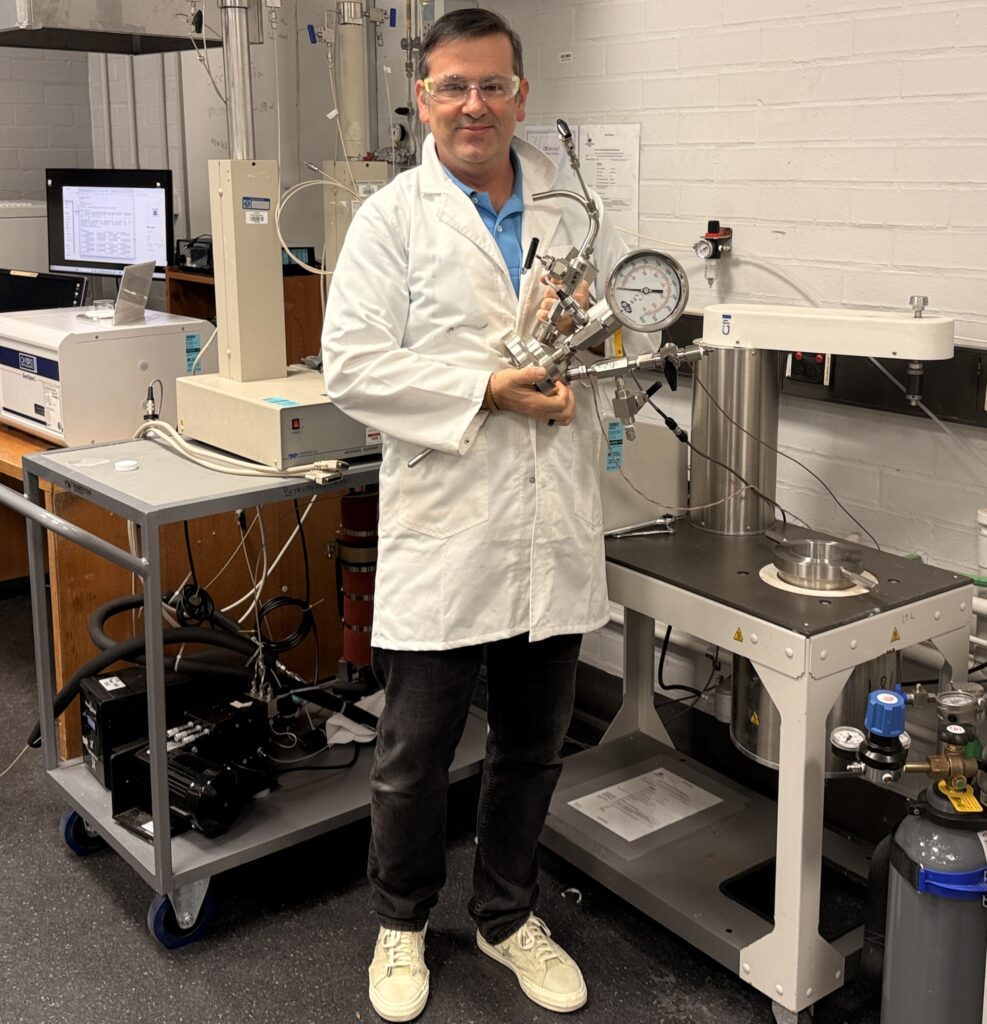
Dr Esteban’s e-poster at GHGT-18 is: Experimental quantification of in-situ induced carbon mineralisation in Australian ultramafic formations with contrasting mineralogy.
“The mineralisation approach changes the nature of the storage problem,” Esteban says. “You are not trying to manage a buoyant plume of CO₂ indefinitely. You are converting it into a solid that is effectively permanent.”
“When you inject CO₂ dissolved in water, there is no buoyancy problem. The water stays wherever you put it. You don’t need caprock to prevent escape, the CO₂ simply remains where it is.”
Harder than it sounds
15,000 kilometres away on the other side of the world, Iceland has proved the concept works. The CarbFix project injected CO₂-saturated water into highly permeable basalt formations, and reported mineralisation within two years. The country’s fresh volcanic geological setting made it almost straightforward and the work there is progressing.
However, Australian conditions are another matter.
“In Iceland they have permeable basalt, abundant water, and geothermal heat. In Australia we have the opposite – tight formations, limited water, and low temperatures at shallow depth,” says Esteban. “This isn’t a copy-paste job. We have to think smart.”
Rocks with the right mineralogy for carbonation, like serpentinites, dunites and olivine-bearing formations, have been so extensively modified over geological time that predicting how they will react is genuinely difficult. A billion years of fluid flow has altered mineralogy, blocked pore networks, and left formations that look promising on paper but behave unpredictably in practice.
Esteban’s lab work is directly addressing this. His team floods core samples of Australian ultramafic rocks under conditions that simulate shallow reservoirs – typically around 500m deep with 50 bar pressure, 60°C temperature – then tracks what happens using imaging, geochemical analysis and petrophysical measurement.
What they have found has revised some earlier assumptions.
The cracks and pores that you might expect to govern fluid penetration have proven not to be the main control on whether mineralisation succeeds. Mineralogy matters more, specifically the mineral composition of the formation and how far it has already been altered by hydration. Temperature is also critical: higher temperatures lower the kinetic barriers to reaction, improving ion mobility and helping reactive minerals to dissolve. At the cool shallow depths CSIRO is targeting, that kinetic drag must be taken into design consideration.
The upshot is that carbon mineralisation in Australia will not be a one-size-fits-all technology. Every site needs what Esteban calls a tailored mineralisation recipe – a specific combination of fluid chemistry, pressure, temperature and injection strategy matched to that site’s geology.

Dr Mihaela Grigore’s e-poster at GHGT-18 is: In situ carbon mineralisation of Australian volcanic rocks
Three paths to build the evidence base
Esteban’s experiments are one part of a coordinated effort across CSIRO.
His colleague, Senior Research Scientist, Dr Mihaela Grigore works at a finer scale, using neutron scattering rather than conventional imaging to follow fluid movement and reaction at the level of individual pores and mineral grain boundaries.
Where Esteban measures bulk behaviour across a sample, Grigore maps the exact pathways fluids travel, where reactions begin, and why certain microstructures help mineralisation along while others inhibit it.
This granular picture is helping the team make sense of what the bulk experiments show.
“If mineralisation takes ten years in real rock, the techno-economics simply don’t work. Reaction speed is one of the critical unknowns we’re working to resolve,” says Esteban.
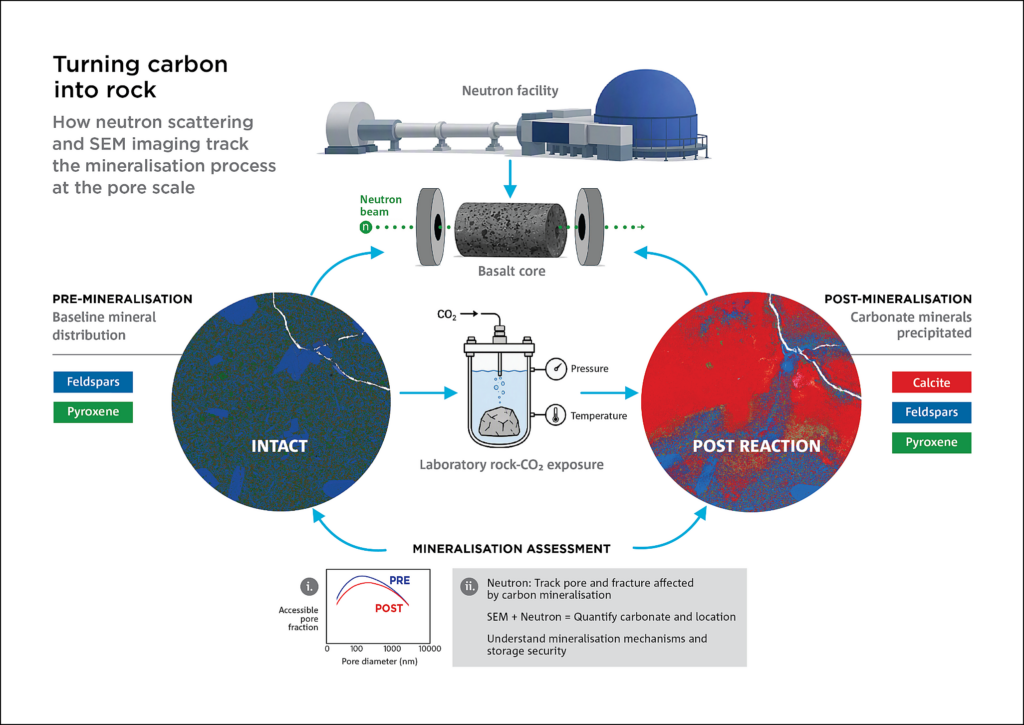
Assessing carbon mineralisation at pore scale combining neutron scattering and SEM imaging on Australian basalts. Carbonate mineral precipitation is not occurring in existing fractures but in the tight mineral matrix in pore size < 100 nm. Existing fractures act as a conduit to feed the surrounding tight mineral matrix to trigger carbon mineralisation.
Dr Saeed Salimzadeh is looking at the problem from the other direction: what mineralisation does to the host rock once it begins.
Dr Salimzadeh’s e-poster at GHGT-18: Hydromechanical Effects of Mineral Carbonation in Ultramafic Rocks
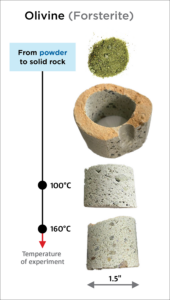
In the laboratory, exposure to pressurised CO₂-rich water at 100°C and 160°C converted the Olivine powder into a consolidated rock, with CO₂ trapped as carbonate minerals (white matrix) between residual olivine grains (green). Increased temperature enhanced carbonate formation and reduced porosity.
New carbonate minerals change porosity, permeability and mechanical strength, which in turn can directly affect how well fluid can keep moving through the formation – and whether the site stays viable for years or decades.
His lab work has produced actual rock from pure Olivine powder by running mineralisation under controlled conditions, giving before-and-after material to test mechanically.
Salimzadeh’s hydromechanical modelling connects Esteban’s geochemical findings to the engineering questions mine operators and project developers will need answered before they commit to a site.
In short, three lines of work: bulk experimental characterisation, pore scale imaging, and hydromechanical modelling.
Together, they are building a picture of how Australian ultramafic formations respond to CO₂-charged fluids across every relevant scale.
The Australian edge
Australia starts from a strong position despite the technical difficulty. The geology is extensive, with mafic and ultramafic geology present in multiple states. CSIRO and Geoscience Australia bring world-class subsurface science capability, and there is an existing CCS infrastructure and regulatory framework to build from.
There is also a broader point. The conditions that make Australia hard – scarce water, tight rocks and remote locations – are precisely those conditions that will constrain carbon mineralisation projects across much of the world. What works here will work elsewhere.
As international attention on in-situ mineralisation as a high-permanence storage pathway is growing, CSIRO is delivering hard evidence to meet it.
“In five years, if everything checks out, we should be able to hand industry a blueprint – this is how to do carbon mineralisation in Australia,” says Esteban.
Carbon mineralisation and hydrogen? Read more here: Orange hydrogen: Could Western Australia’s rocks help power a low-carbon future? – CSIRO