
Time to match carbon storage monitoring to actual risk: The five questions regulators, industry, researchers and communities most want to understand.

Dr Karsten Michael….
When carbon is stored underground, regulators require a “closure period” – a waiting time between stopping injection and officially handing back the site licence. But how long is long enough? Here are the five questions regulators, industry, researchers and communities most want to understand.
Geological storage of CO2 is one of the few available tools capable of reducing carbon emissions at the huge scale that can help governments and industries meet their net zero targets. It works by injecting captured CO2 deep underground into porous rock formations, where it is permanently trapped.
Done well, it is safe, effective and increasingly essential. But it raises a question that regulators, industry and communities are concerned about, but that still hasn’t been answered for a real world project: once injection stops, how long does a CO2 storage site need to be monitored before it can be signed off and the licence surrendered?
Jurisdictions around the world currently handle this inconsistently, applying fixed closure periods ranging from 15 to more than 100 years. Tellingly, the period is not generally tailored to the actual risk profile of any individual site and has not yet been applied in practice because no storage site has been decommissioned to date.
Research and evidence can now help inform a more fitted approach.
Offshore, where most of Australia’s prospective storage sits, the challenge is compounded by the practical limitations of monitoring in a marine environment, the presence of ecologically sensitive areas protected under federal law, and the reality that decommissioning offshore wells effectively ends most capability of directly monitoring the CO2 plume in the reservoir anyway.
The stakes are real. Too little monitoring may risk undetected leakage, with potential consequences for the marine environment, neighbouring subsurface resources, and public confidence in carbon capture and storage (CCS) as a technology. Too much, and the financial and regulatory burden may deter the very investment needed to make large-scale carbon storage happen.
CSIRO has been working on CCS for more than two decades, developing expertise that spans subsurface geology, reservoir modelling, environmental risk assessment, monitoring technologies and regulatory frameworks. That breadth, and CSIRO’s position as an independent national science agency, makes it a trusted source of advice for governments, industry and the community.
Dr Karsten Michael, Principal Research Scientist in CSIRO’s team looking at geological storage of CO2 and who is presenting at GHGT18 in Perth this year, reflects on the five questions regulators, industry, researchers and communities most want to understand about post-injection monitoring, and what the science currently tells us.
Q1: What are the real risks of leakage – and how serious could they be?
This is usually the first question we get from regulators and the community. For a properly designed and regulated storage site, significant leakage is unlikely; for depleted hydrocarbon fields it is considered negligible; and for well-characterised saline aquifers with confirmed storage capacity and containment security it is low.
The riskiest time for any injection well is during and immediately after active injection finishes, when subsurface pressures are highest. And the biggest risk after injection stops is not geological leakage through the rock. It is well leakage as a result of degrading casings or cement, or poor engineering design. This risk increases with the number of wellbores penetrating the CO2 plume area.
On the positive side, if well leakage occurs, it is typically localised and can be addressed using standard industry well intervention techniques; the more serious scenarios, such as well blowouts and pipeline ruptures, are rare and have well-established response protocols.
In the offshore marine environment, even a large volume of CO2 leakage disperses rapidly in the water, limiting environmental impact; fish, mammals, birds and reptiles are generally not directly vulnerable, and will avoid bubbles. Corals are the important exception: sustained CO2 exposure would cause acidification of the seawater and could cause localised impacts on growth and species richness within a reef system.
All this underlines why site selection and a deep understanding of its subsurface characters like geology, pressure and temperature are the most important safeguard against leakage.
Q2: What happens underground after CO2 injection stops – and why does it matter for monitoring?
When injection stops, pressure in the reservoir gradually dissipates and the CO2 plume begins to stabilise, but the timeline and behaviour vary significantly depending on geological formation. In depleted oil and gas fields, pressures are typically already low and the CO2 behaves relatively predictably; in saline aquifers, pressure can remain elevated for longer and the plume may continue to migrate.
The containment risk is typically highest in the period immediately after injection stops and generally declines over time, which means the intensity of monitoring can be progressively reduced as confidence grows. Understanding this risk trajectory is fundamental to designing a closure period that is proportionate, rather than simply applying a standard monitoring period. Specific monitoring would be required, for example, in specific circumstances where the CO2 plume contacts an abandoned well post-injection or in an environmentally sensitive environment.
Q3: How do we know when it is safe to stop monitoring? Do all sites require some form of post-closure monitoring?
The ‘gold’ standard for monitoring is that it should continue until risks have been reduced to “as low as reasonably practicable” [ALARP]. Key indicators include reservoir pressure returning to near-background levels, the CO2 plume stops moving and stabilises, confirmed well integrity, and no induced seismicity. Over time, as these indicators improve, monitoring can be scaled back to match the reduced risk.
But there is no universal endpoint; when to stop monitoring a site should be grounded in site-specific data provided by the operator to the regulator. In many cases the evidence base collected during CO2 injection operations can inform a shorter closure period.
After decommissioning and CO2 licence surrender, monitoring it is not standard practice in comparable industries, unless locations have exceptional circumstances, such as sites near ecologically sensitive areas.
Q4: What does proportionate post-injection monitoring look like – and what are the limits?
Technical studies such as well-based pressure and temperature measurements, occasional wireline logs, and a final 3D seismic survey are generally enough to meet regulatory expectations at most sites.
Environmental monitoring of the seabed and water column is not a routine requirement and is typically only used if subsurface data indicates a potential loss of containment.
Monitoring has practical limits that regulators and operators must plan for: the reality is that once offshore infrastructure is decommissioned to an agreed funded plan, access to wellbores is lost and instrument power is cut, ending most monitoring capability.
Moreover, monitoring is not without impact. It carries environmental costs, seismic surveys add incremental risk to marine life and are regulated under Australia’s EPBC Act.
The shared, responsible goal should be a tiered and risk-based adaptive approach: more comprehensive monitoring early in the post-injection period, reducing as confidence grows, with clear and agreed triggers for escalation if anomalies are detected.
Q5: Why does getting the regulatory framework right matter beyond any single project?
The regulatory approach Australia develops now will set a precedent: with multiple offshore CCS projects in assessment or development, the frameworks being built today will shape the industry for decades.
Getting this right is not just about managing risk at individual sites. It is about whether geological storage can be deployed at the scale and pace that is required to mitigate climate change.
CSIRO’s role is to provide the regulator, industry and public with the best available science to make informed regulatory decisions, understand the environmental risks and help establishing a reliable monitoring framework that distinguishes between what monitoring is genuinely necessary and what is precautionary in name only.
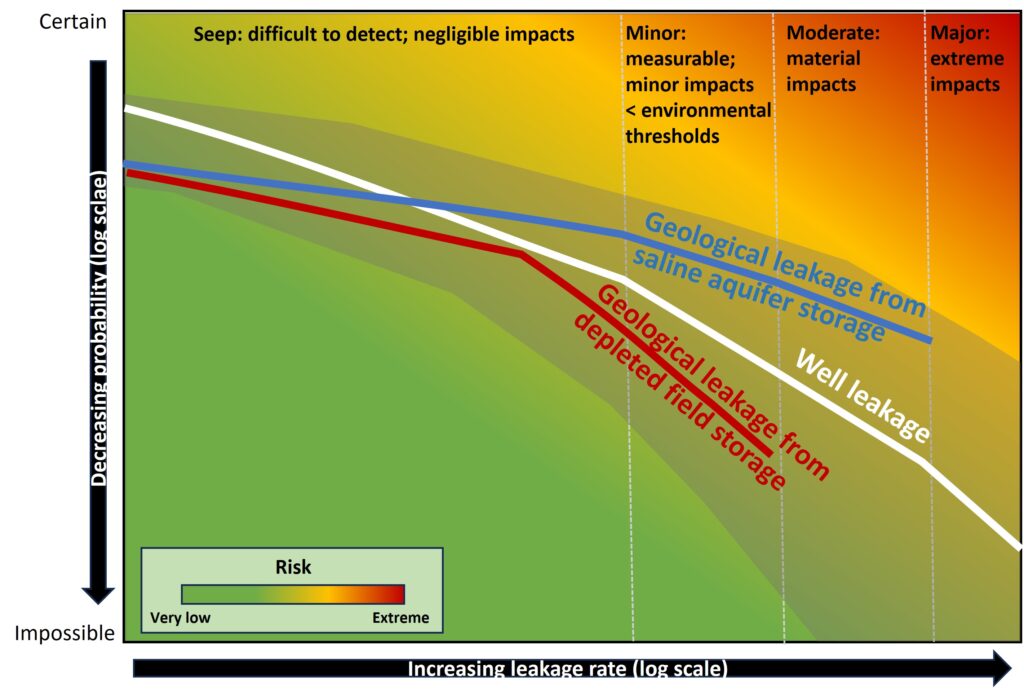
CO2 Leakage Risks: Generalised categorisation of CO2 leakage risk for different storage types and leakage pathways based on experience from the petroleum industry and natural analogues.