
New geochemical screening tool predicting rock reactions for safer CO₂ storage
When companies plan to store carbon dioxide underground as part of efforts to tackle climate change, one of the biggest questions is: what happens when CO2 meets rock, deep underground, over long periods of time?
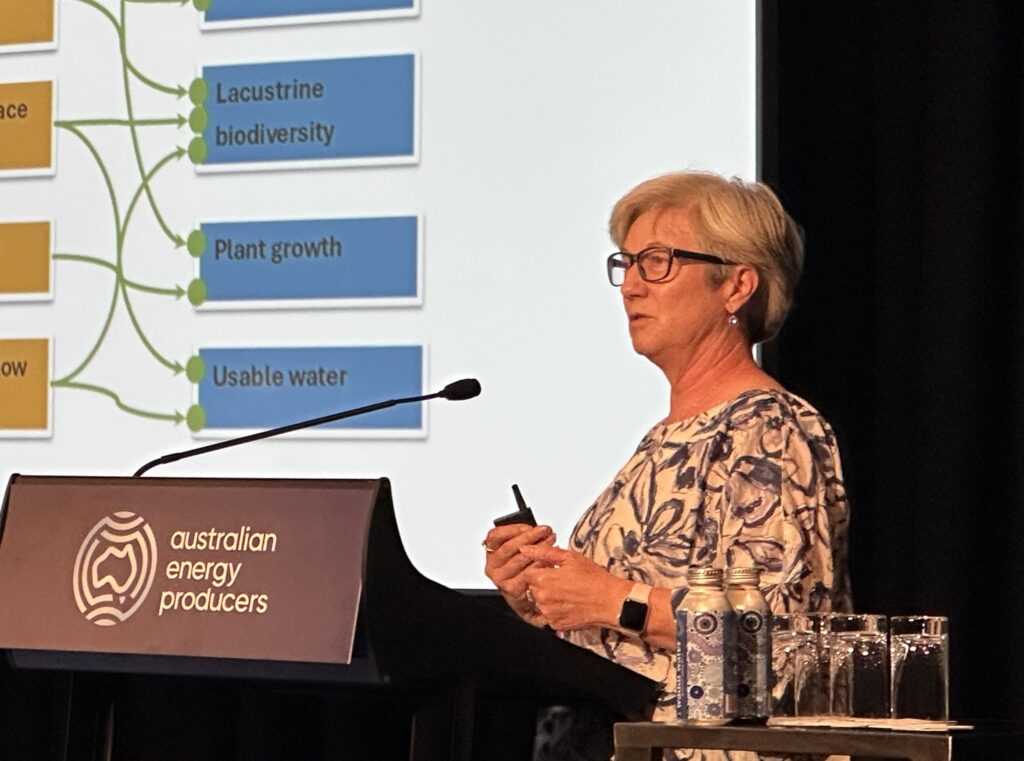
Dr Stalker’s career research has contributed to major carbon capture and geological storage projects in the areas of geochemistry, monitoring, social licence to operate, and community education.
Researchers at CSIRO have spent several years investigating exactly this question, developing a screening tool that helps predict how CO2 will interact with the rocks at a geological storage site, and what that might mean for a project’s success.
For a carbon capture and storage (CCS) project to work, the chosen underground location needs three things: enough space to store the CO2, a secure seal to keep it in place, and rock that allows CO2 to flow into it at a reasonable rate. In Australia, sandstone is the most common storage rock, though limestone can also work well.
That third requirement, getting the CO2 to flow into the rock, depends on the rock’s porosity and permeability. This is where things get complicated. When CO2 is injected underground, it can chemically react with the minerals in the rock. Sometimes these reactions dissolve minerals, opening more space and making it easier to inject CO2. Other times, new minerals may form and clog up that space, making injection harder.
If the rock becomes harder to inject into overtime, companies may need to drill additional wells to maintain their planned injection rates, an expensive outcome project operators want to avoid.
A screening tool for early risk assessment
To help companies understand these risks before committing to a site, CSIRO has developed a workflow using geochemical modelling software (Geochemist’s Workbench) to simulate what happens when CO2 is introduced to a particular rock formation.

Dr Chaudhari
The work has been led by Dr Linda Stalker, a CSIRO Senior Principal Research Scientist alongside Dr Alok Chaudhari, a CSIRO Research Scientist and geochemist and Dr Chris Green – who will be presenting this work at the GHGT-18 conference in Perth in October.
“What we’ve tried to do is build something practical, a tool that gives project teams an early read on whether their chosen rocks are likely to behave well, without needing years of expensive sampling before they can even start,” Dr Stalker said.
The modelling considers the minerals present in the rock, its porosity, temperature, pressure, and how long the CO2 will be injected for. From there, researchers can predict what might happen not just during injection, but for up to a thousand years afterwards, providing a long-term view of how secure the storage will be.
“Mineral reactions underground can be slow, but over the lifetime of a storage project, even small changes in porosity can add up to a big difference in how easily CO2 can be injected. These reactions can also lock the CO2 into stable mineral phases, effectively locking the injected CO2” Dr Chaudhari said. “Being able to model that ahead of time means companies can plan for it, rather than be caught out by it.”
This isn’t just about the storage rock itself. The same approach can assess the ‘topseal’, the layer of rock that sits above the storage zone and prevents CO2 from migrating upwards. If CO2 reactions cause this seal to dissolve or weaken, it could create a pathway for leakage into an overlying aquifer, a concern for regulators and the public alike.
The geochemical screening sits alongside CSIRO’s broader subsurface modelling capability for CO2 storage, led by researchers including Dr Green, who specialise in the numerical and theoretical modelling of how CO2 moves through underground rock formations. He has been involved in several field-scale simulations of CO2 storage projects in Australia and is a core developer of the Porous Flow module in the open-source MOOSE simulation framework.

Dr Green is also currently involved in modelling large-scale underground hydrogen and thermal energy storage projects.
“Changes to porosity and permeability don’t just affect how easily CO2 can be injected at the wellbore, they can also reshape how the CO2 plume spreads out underground over time,” Dr Green said. “Feeding the geochemical results into our flow models helps us build a more realistic picture of where the CO2 will end up, and how confident we can be in that picture.”
Filling a gap in the scientific research
Decades of research from the oil and gas industry has provided valuable insights into how reservoir rocks behave when CO2 is naturally present, particularly from studies of mineral changes during oil and gas formation, and from previous work on generation of secondary porosity.
However, topseal rocks weren’t seen as a priority for sampling or study, since depleting an oil or gas reservoir reduces pressure, which was assumed to reduce the risk of the seal failing.
For CO2 storage, where pressures may increase rather than decrease, this gap in understanding geochemical behaviour in topseals and the need for data is one CSIRO’s research aims to help address.
With regulators wanting assurance that companies have properly assessed these geochemical risks before approving a storage project, CSIRO’s screening tool provides a practical, science-based way to demonstrate how CO2 might affect both the storage reservoir and its overlying seal, and to flag where additional monitoring might be needed.