
Positioning Australia for regional decarbonisation
As the world looks to accelerate decarbonisation, attention is expanding beyond carbon capture to a critical link in the value chain: how we move CO₂ safely, efficiently and at scale across borders.
By Ruth Dawkins

Dr Mark Tocock
When the world’s leading carbon capture, utilisation and storage (CCUS) researchers gather in Perth this October for GHGT‑18, the conversation will logically extend beyond capture technologies. Increasingly, attention is turning to a critical but less visible component of the CCS value chain: the transportation of captured carbon dioxide for storage.
As co‑host of the conference, CSIRO will play a prominent role in shaping these discussions. Among the Australian researchers presenting is Dr Mark Tocock, whose work examines the feasibility of transporting low‑temperature, low‑pressure liquid CO₂ across the Asia‑Pacific region for permanent geological storage in Australia. His findings point to a significant opportunity for Australia to support regional decarbonisation.
Carbon storage is a regional challenge with global implications
In addition to storing domestically captured CO2, Australia has large quantities of geological stable land providing potential to import and store CO2 from other Asia-Pacific countries less able to rapidly reduce their emissions to reach their net zero targets.
Managing trans-border transport of CO2 as part of a global energy system could empower countries endowed like Australia to support global efforts.
This could help to reduce emissions from diminishing fossil fuel use and industrial processes (like those generated by cement or steel production), maintain revenue from its geological resources, develop new markets for CO2 sequestration and address the downstream CO2 emissions generated by countries using Australian sourced energy supplies – known as scope 3 emissions.
For example, Japan buys more than 40 per cent of its liquified natural gas from Australia. When Japanese utilities combust this gas for electricity generation, they produce CO2 emissions. Japan has limited CO2 storage potential. However, if emissions are captured locally and exported for storage, Australia could compete in, and participate in, a new market for the international sequestration of CO2.
Assessing the feasibility of CO₂ shipping
CSIRO’s research, undertaken as part of the Northern Territory Low Emissions Hub business case project, evaluates the technical, logistical and economic considerations of shipping CO₂ from Japan to Darwin. The study combines a detailed logistics model with a techno‑economic assessment, supported by a review of international standards and extensive stakeholder engagement.
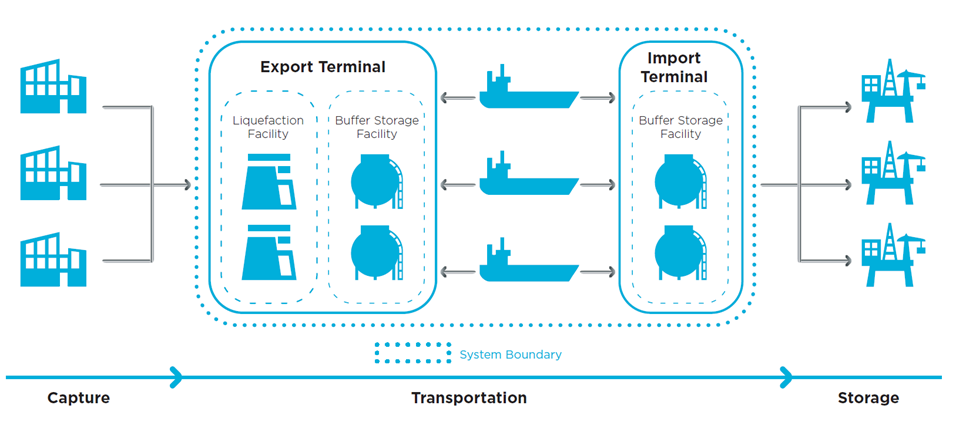
The system boundary includes liquefaction, buffer storage at both export and import terminals, shipping, unloading, and preparation for permanent underground storage. This reflects the full value chain required to move CO₂ from capture source to geological reservoir.
Modelling suggests that transporting between 1 and 6 million tonnes per annum (Mtpa) of CO₂ would require between two and eleven ships, depending on vessel size. Three ship capacities – 40,000 m³, 60,000 m³ and 80,000 m³ – were assessed. The levelised cost of transportation ranges from A$122 to A$224 per tonne, with economies of scale driving costs down at higher volumes. The lowest modelled cost of A$122 per tonne would require a fleet configuration of five 80,000 m3 ships transporting the maximum assessed volume of 6 Mtpa.
At these larger scales, more than half of the levelised cost is associated with the capital and operational expenditures of the shipping fleet itself. Sensitivity analysis highlights the influence of port charges, fuel prices, carbon pricing, and the design of buffer storage facilities.
While these costs are substantial, they are broadly consistent with international estimates and reflect the nascent stage of the industry. Importantly, the modelling identifies clear pathways for cost reduction as infrastructure scales and technologies mature.
Technical readiness: no show‑stoppers
A key component of the study involved validating assumptions with shipbuilders, terminal operators, researchers and demonstration project leaders in Europe and Asia. This included site visits to Norway’s Northern Lights project: the world’s most advanced CO₂ shipping and storage operation.
The geographic realities of the Asia-Pacific region demand a different engineering approach than that seen in Europe. While European operations utilise medium-pressure vessels to cross short distances of a few hundred kilometres, regional transport to Australia involves voyages lasting up to 11 days one way. To make these immense distances economically viable, the industry needs to pivot toward low-temperature, low-pressure shipping regimes, which allow a vessel to hold nearly double the cargo of an equivalent elevated-pressure counterpart.
However, operating at a low-pressure regime introduces distinct thermodynamic complexities. It requires managing the liquid CO₂ incredibly close to its “triple point” – the precise temperature and pressure where carbon dioxide can coexist as a liquid, gas, and solid. If the cargo tanks experience rapid pressure drops or temperature fluctuations, there is a risk of dry ice formation inside the system. This risk is mitigated by maintaining strict pressure and temperature control, using boil-off gas management and pressure regulation systems to ensure operating conditions remain safely away from the triple point.
Acknowledging these challenges, stakeholders were asked whether any technical limitations would prevent the scaling up of low‑pressure, low‑temperature CO₂ carriers to the sizes assumed in the modelling. The response was consistent.
“There are no technical barriers to scaling up liquid CO₂ carriers,” Dr Tocock says. “The industry is already moving quickly, and the engineering challenges are well understood. While many solutions are already available, such as newer steels for cargo tanks and onboard reliquefication systems, demonstration projects are required to validate their performance at larger cargo scales and reduce uncertainty for both industry and regulators.”
Low‑pressure shipping is expected to become the standard for long‑distance transport in the Asia‑Pacific region. While impurities in the CO₂ stream require management, most are removed during chemical capture processes, reducing risks to vessels and storage infrastructure.
The research notes that the most significant uncertainties relate not to engineering, but to supply chain dynamics such as the availability of shipyard capacity and the timelines for constructing larger vessels.
While the modelling explores an ultimate design target of 80,000‑tonne vessels, stakeholder feedback indicates that the industry is likely to scale in stages. In the near term, ship capacities are expected to increase only to around 50,000 tonnes as the market matures and global shipyard capacity expands. This staged development reflects commercial and manufacturing realities rather than engineering constraints.
The real barrier: cost, scale and social licence
Although the technical pathway is increasingly clear across the CCS value chain, Dr Tocock emphasises that primary barriers to establishing a regional CO₂ shipping industry are economic, regulatory and social.
“While CSIRO is working with government and industry to research and respond to cost challenges and engage on community concerns, currently, fiscal mechanisms are not in place in the Asia Pacific,” he explains. “In this region, carbon prices are far lower than in Europe, and there are comparatively limited incentives for carbon dioxide emitters to capture and transport CO₂.”
European progress in CCS has occurred over a relatively compact region, been supported by carbon pricing, targeted government subsidies, and closely coordinated regulatory frameworks. Countries in the larger Asia Pacific region are continuing to develop bilateral agreements, potential accounting mechanisms and agreed regulations to facilitate private investment participation in cross‑border CO₂ movement.
For a nascent shipping‑based CCS value chain to functions, both exporting and importing countries must be incentivised to participate. Carbon dioxide emitting industries need confidence that captured CO₂ will be accepted and stored securely, while storage operators require predictable revenue streams to justify investment in infrastructure.
“If two countries want to engage in cross-border CCS, it requires government‑to‑government agreements on regulatory frameworks, carbon accounting, community acceptance and long‑term commitments,” said Dr Tocock.
A strategic opportunity for Australia
As Asia‑Pacific countries seek pathways to realise their net zero goals and reduce emissions, Australia is playing a constructive, leading role across the region’s energy sector – working to advance the electricity transition and decarbonise hard-to-abate industry and transport. With significant geological storage capacity, established research expertise and emerging infrastructure, the nation could become a future regional hub for cross border CO₂ transport.
Dr Tocock believes that GHGT‑18 in Perth represents a valuable opportunity to advance conversations around this potential and continue to build shared understanding among researchers, policymakers and industry stakeholders and the community about the role of CO₂ transport, and the settings needed to enable it.
Beyond sharing techno-economic data, Dr Tocock aims to use the international platform to achieve two distinct research goals: dispelling lingering technical myths within current literature regarding low-pressure transport limits; and advocating for a dedicated physical demonstration project. While localised test vessels exist overseas, the industry lacks real-world operational experience moving full liquid CO₂ payloads over the vast maritime distances of the Asia-Pacific region.
“Developing the technology is only half the battle,” Dr Tocock notes. “Scaling it requires the entire ecosystem to move together. De-risking this industry means moving from hypothetical studies to real-world regional demonstrations.”
As GHGT‑18 approaches, CSIRO’s research provides a timely and evidence‑based foundation for these discussions, highlighting both the promise of CO₂ transport and the frameworks needed to make it a reality.
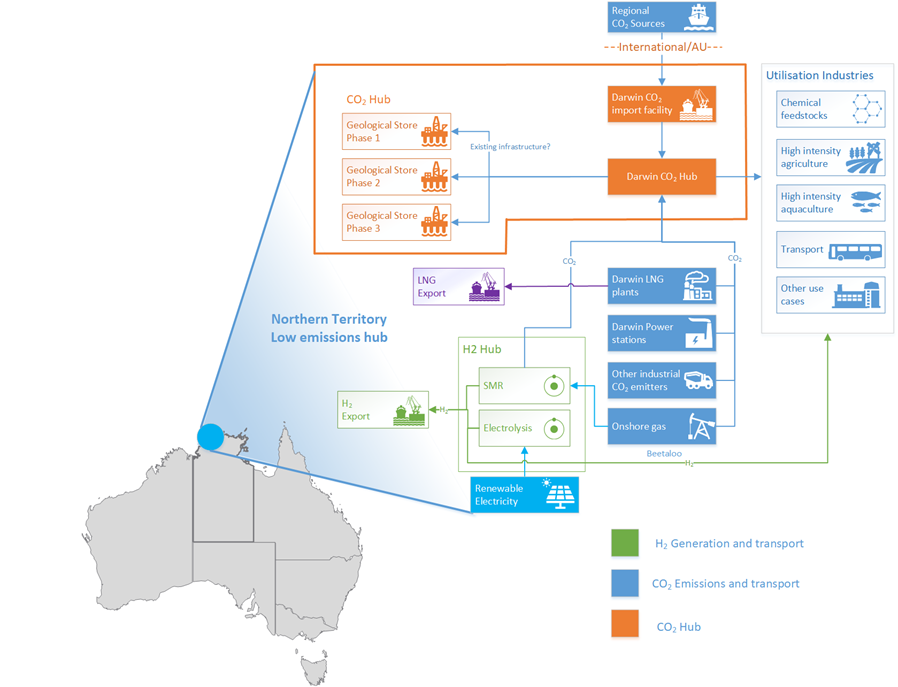
A vision for a low emissions hub in Australia’s Northern Territory