Australia’s future carbonauts: Building the next generation of carbon capture expertise
- Curtin University students are working alongside CSIRO researchers at the Carbon Capture Materials Acceleration Centre (CCMAC) in Perth.
- The future scientists are levelling up to help innovate technologies to remove CO₂ from the atmosphere, decarbonising the planet.
- Be bold, go deep, be patient: Nobel chemistry laureate, Professor Omar Yaghi shares insights for early career researchers.
By Ruth Dawkins and Scott Walker
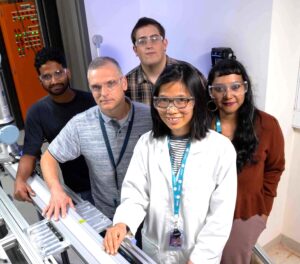
Development pathways for early career candidates in direct air capture is a key ambition for Dr Colin Wood and the new Carbon Capture Materials Acceleration Centre his team is building in Perth.
When Taj Baird was five years old, his brother broke an iPad, and Taj decided he would try to fix it. His tool of choice was a hammer.
“In retrospect, it probably wasn’t the smartest idea,” he laughs.
But the instinct behind that early experiment – wanting to pull things apart, understand how they work and put them back together – stuck. Encouraged by a grandfather who loved working on old cars and a dad who helped him work on his own, Taj eventually found his way to engineering.
Now in his first year at Curtin University, Taj is putting that curiosity to work at CSIRO’s Carbon Capture Materials Acceleration Centre (CCMAC) – gaining hands-on experience in a research environment at the beginning of his engineering career.
“I haven’t even started my major yet, but I’m planning on doing mechanical engineering with finance,” Taj says. “I got into CSIRO at the start of my second semester, so I was really happy with that.”
Taj is one of several Curtin students and early career researchers working at CCMAC on solving the challenges of direct-air-capture (DAC) of CO2, bringing together an unusually diverse mix of experience – from someone just beginning an engineering degree to PhD students with years of industry and life experience behind them.
The different pathways reflect a foundational CCMAC ambition: to mature the next generation of chemists, engineers, data scientists – whatever is needed – to accelerate the DAC technologies needed to realise a cleaner, productive world.
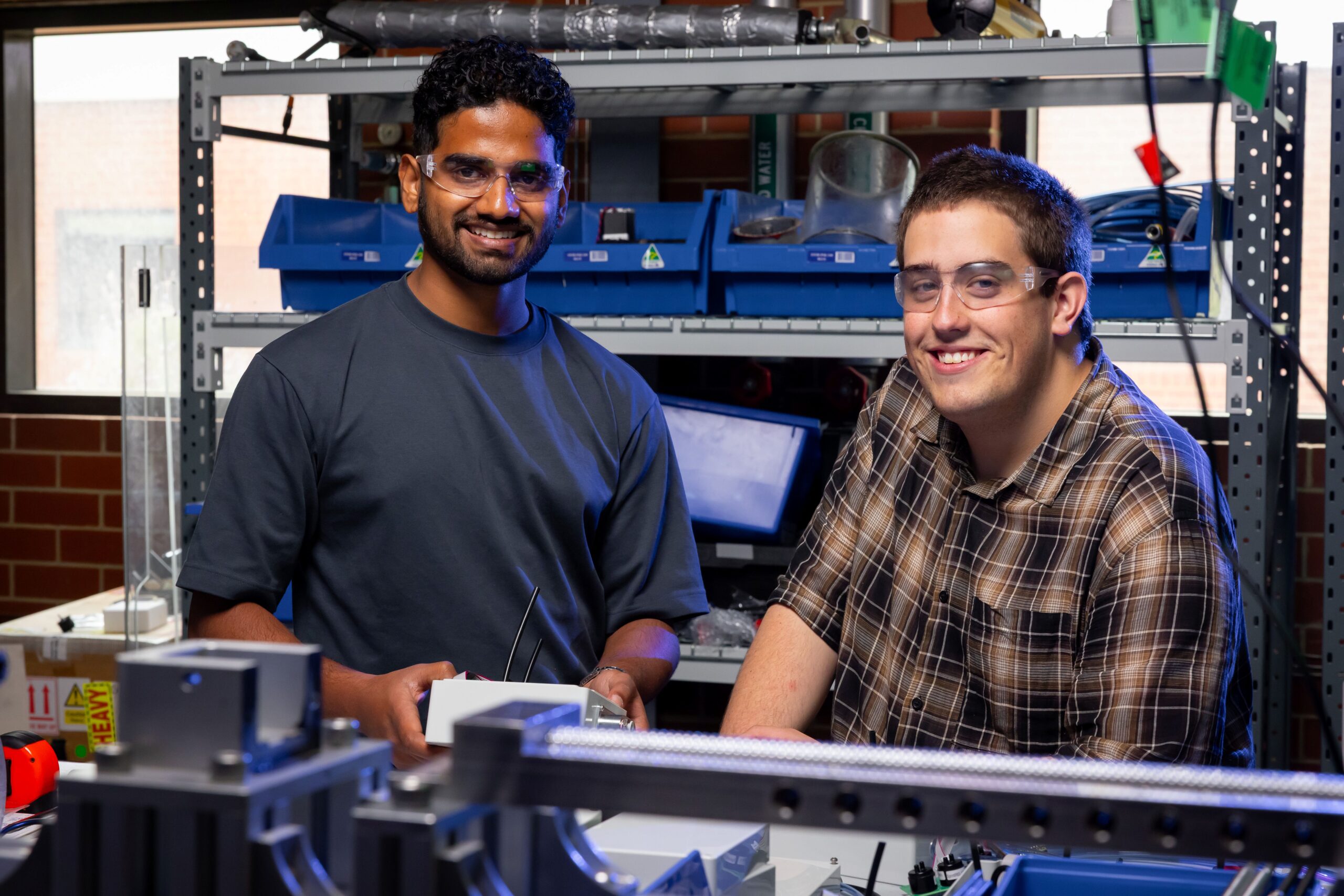
Curtin University undergraduate engineering students, Tamil Masilamani and Taj Baird working in the new Carbon Capture Materials Acceleration Centre (CCMAC). Photo credit: CatchCreate
Different pathways, shared curiosity
While Taj is just beginning his time at Curtin University, Tamil Masilamani is nearing the end of his. Also studying mechanical engineering and finance, he is currently in his fifth and final year.
Raised in Perth by first-generation Indian parents, Tamil was drawn to engineering through a love of maths and physics but also by a curiosity about the engineered world around him – from cars, trains and planes to skyscrapers and large infrastructure.
“Everything always comes back to engineering,” he says. “Whether it’s breaking big rocks into smaller rocks or putting up buildings – we’ve been doing that for decades, centuries and millennia .”
When the time came to choose an honours project, he learned about an opportunity to work at CSIRO. Carbon capture immediately stood out from the other options.
“Climate change is a big personal interest of mine,” Tamil says. “I see all the different ideas and solutions we’re trying to come up with to combat climate change and find that really interesting.”
At CCMAC, Tamil is working with mass flow meters on bench-scale carbon capture units, running experiments to understand whether they are accurately measuring what is being captured and diagnosing and fixing problems when they arise.
For Taj, the work is similarly hands-on. He is building CO₂ sensor boxes that researchers can swap between systems to test different ranges of CO₂ concentrations.
“It feels amazing to actually see my work help other people do theirs,” he says. “I never really wanted to be one of those engineers that just sits at a desk all day. I wanted to be able to build things.”
Bringing experience back to research
For PhD students Hong Tran and Divya Iyer, the path to CCMAC has been considerably longer.
Hong is in the second year of a PhD in chemical engineering, researching materials for direct air capture. But before beginning her PhD, she spent 15 years working in industry.
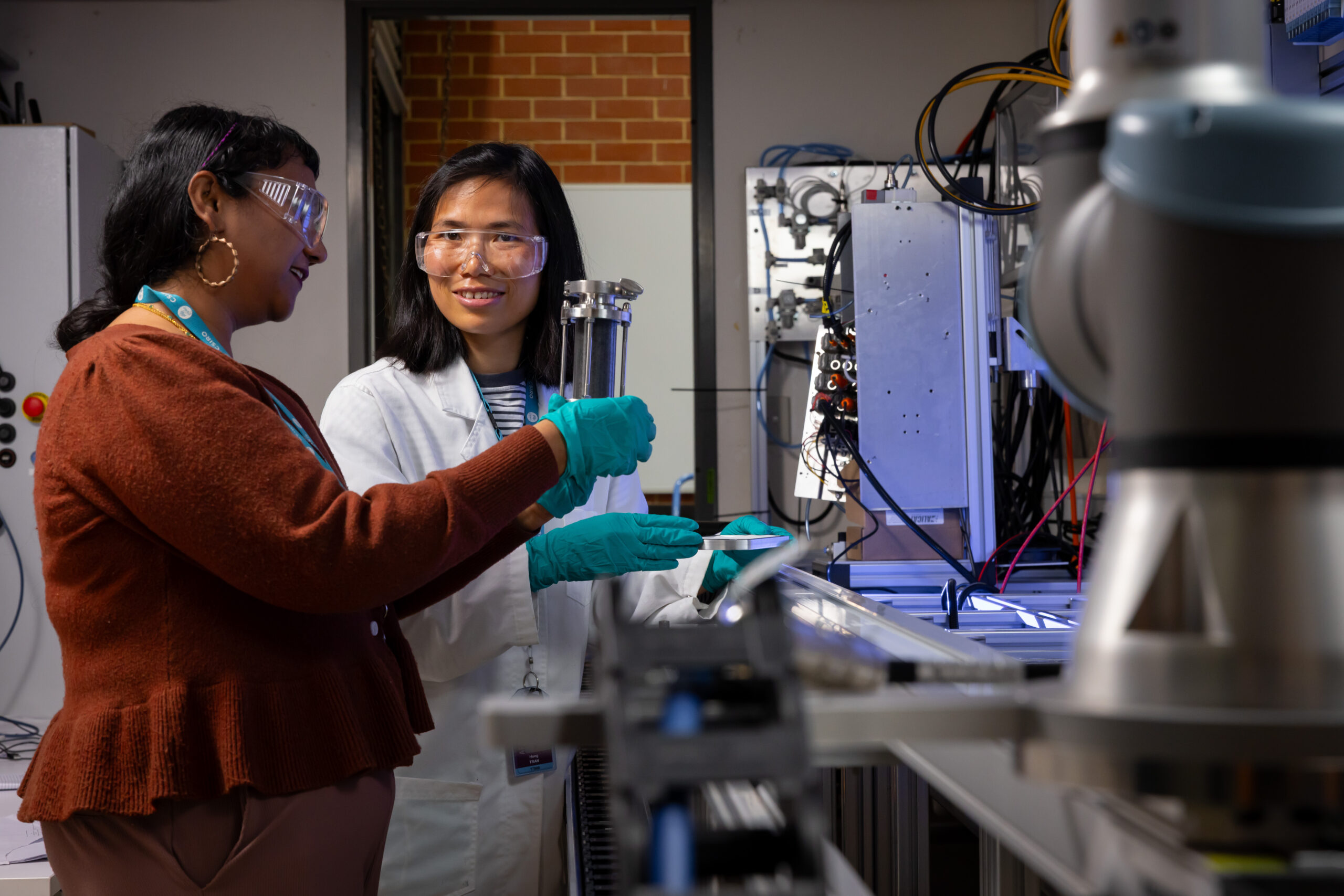
Curtin University chemistry PhD students Divya Iyer and Hong Tran in the new CCMAC facility. Photo credit: CatchCreate
After completing a chemical engineering degree in Vietnam, specialising in polymer science and technology, Hong built a career spanning sustainability, resource efficiency, waste management and plastics recycling. She later completed a Master of Environmental Management in Australia before returning to her original interest in materials science.
“I value the strong research foundations and expertise within academia, and I particularly enjoy how working with CSIRO complements that experience through its focus on practical applications and industry needs,” says Hong.
“I’m very practical myself,” she says. “I need to focus on finding solutions to real problems.”
That potential for real-world impact attracted her to CCMAC. She is interested in how materials can be tested, optimised and eventually scaled towards something industry could use.
Hong is particularly excited about the potential to combine mineral carbonation with DAC to lock captured CO2 away permanently, turning mine tailings and mine wastes from an environmental liability into a valuable asset for carbon removal.
Divya is also a second-year chemical engineering PhD student. Before starting at Curtin, she completed postgraduate chemistry studies in India and at Texas Tech University in the United States. She also held roles in pharmaceuticals, chemicals manufacturing and water treatment, and spent several years teaching high school before returning to university for a PhD.
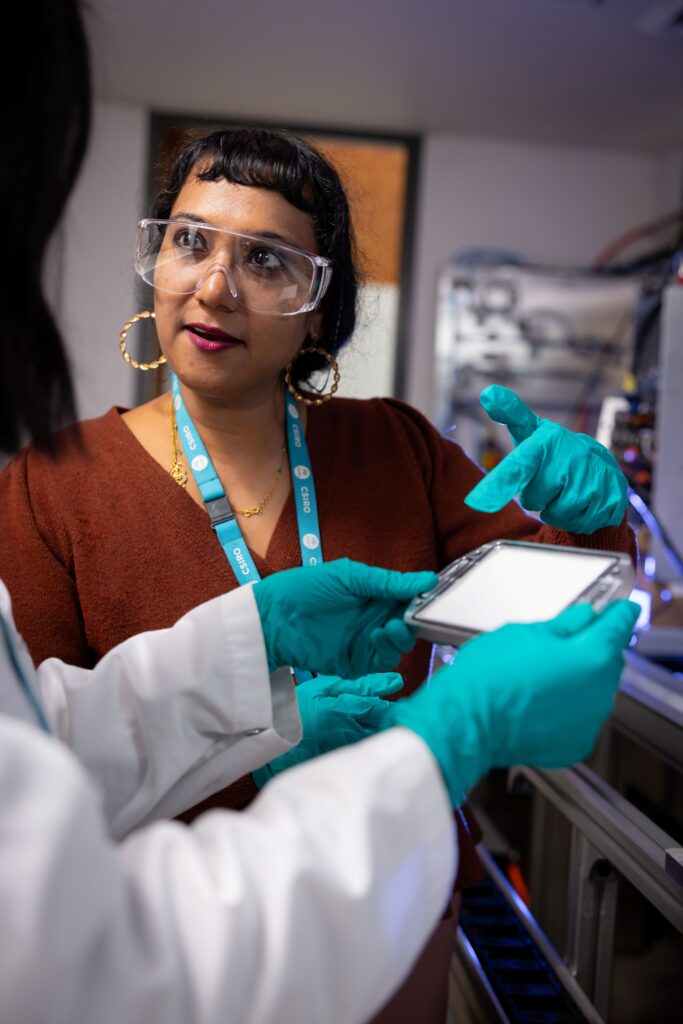
Divya Iyer will work at CCMAC over several years and is excited to be part of the lab’s early days and the discoveries ahead. Photo credit: CatchCreate
Her research focuses on advanced adsorbent materials for carbon capture and gas separation under industrially relevant conditions. Working with CCMAC allows her to explore beyond the materials at the centre of her PhD and investigate new possibilities.
For Divya, joining a research centre at such a nascent stage is part of the appeal.
“Being part of the lab’s early days is the most exciting part here,” she says. “It gives me a lot of flexibility to try different things.”
With her work at CCMAC extending over several years rather than a short internship, Divya can think bigger – potentially working towards outcomes such as a publication or patent.
Seeing where engineering can lead
Across very different career stages, all four students describe the value of working alongside CSIRO researchers with expertise spanning different disciplines.
“It’s amazing to collaborate with them because you get to learn something new each and every day with every conversation,” Divya says.
For Taj, conversations with researchers and engineers across CSIRO are helping him explore possibilities for the future – including his interests in aerodynamics and space.
Tamil has experienced a similar shift.
He had expected mining to be the obvious destination after graduation. But working at CCMAC has introduced him to career options he had not seriously considered before. Research and design are now firmly among them.
Hong and Divya, meanwhile, both see industry in their futures – but with a stronger understanding of how research and practical application can intersect.
Collectively, their experience confirms there is no single pathway into CCMAC – and no single destination emerging from it. It’s a view shared by those at the global leading edge of science and research.
Insights from the Nobel Prize in chemistry
Professor Omar Yaghi, who now leads the new AI Chemistry and Materials Research Institute (AIMATRY) at Tsinghua University, was awarded the 2025 Nobel Prize for Chemistry.
Together with Professors Susumu Kitagawa and Richard Robson, they pioneered the development of metal–organic frameworks (MOFs).
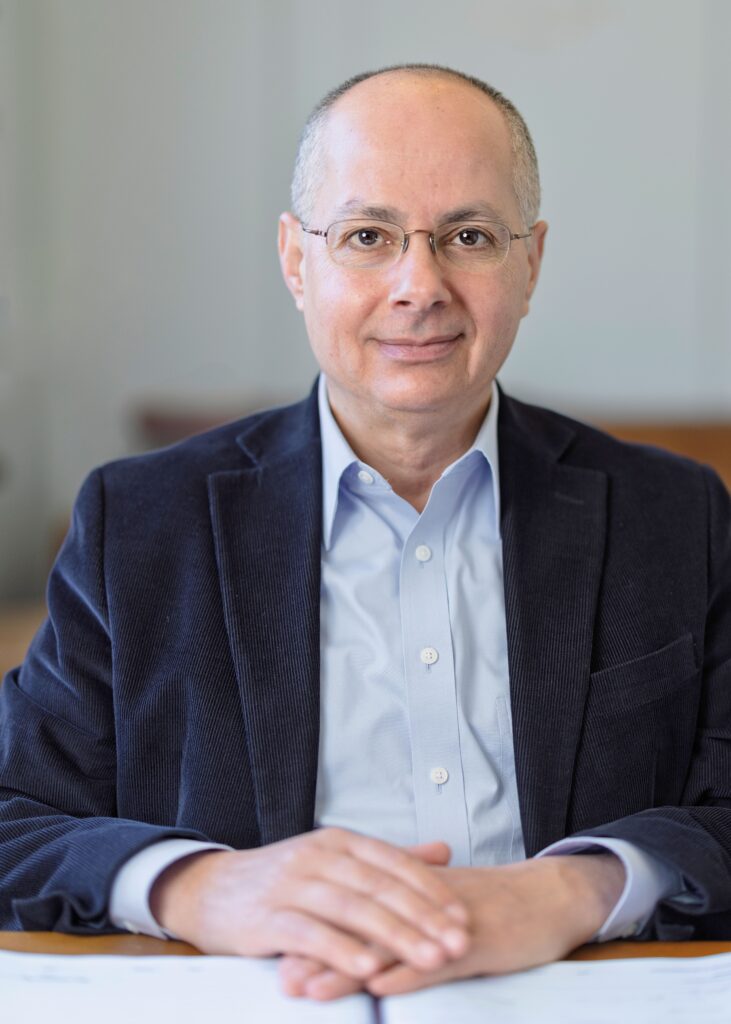
2025 Nobel Prize for chemistry awardee, Professor Omar Yaghi: Choose what is most meaningful to pursue, guided by scientific understanding, experiment, and ultimately societal purpose. Photo credit: Christopher Michel.
These highly porous materials can be designed to capture and store specific substances, with potential applications ranging from harvesting water from desert air to capturing CO₂ directly from the air.
For Professor Yaghi, who has read these early experiences of Divya, Hong, Taj and Tamil, direct air capture offers young scientists an opportunity to work across traditional disciplinary boundaries.
“Direct air capture is one of the most demanding separation problems we have chosen to tackle because carbon dioxide is present in air at such low concentration. That difficulty is precisely why the field is so important for young scientists,” Professor Yaghi said to CSIRO.
“It sits at the intersection of chemistry, materials science, chemical engineering, mechanical engineering, AI, and ultimately deployment at scale. Progress will not come from one discipline alone. It will come from scientists and engineers who are willing to work across boundaries and who understand that the path from a molecule to a functioning system is as intellectually rich as the discovery itself.
“DAC will also be important in closing the last gap to net zero—the residual emissions that remain even after deep reductions elsewhere.
“My message to students entering this field is to begin with fundamentals and resist the temptation to think only in terms of the immediate application.
“Many of the most transformative technologies arise from basic questions that at first seem disconnected from societal needs.
“In my own work, we did not begin by asking how to capture carbon dioxide from air; we asked whether molecular building blocks could be linked together with precision to create extended structures. That fundamental question led to reticular chemistry and, much later, to materials with extraordinary promise for carbon capture and many other applications.
“Today, AI is moving materials discovery from scarcity to abundance: we can imagine and generate far more possibilities than we could ever make and test. The challenge is therefore increasingly one of selection – choosing what is most meaningful to pursue, guided by scientific understanding, experiment, and ultimately societal purpose.
“I would encourage young scientists to be ambitious, master the fundamentals, and learn how to make good scientific choices in this new landscape.
“Direct air capture needs exactly that combination of deep science, AI, bold engineering, and patience,” Professor Yaghi says.