Session Highlights
For a decade, the ON Innovation Program has evolved alongside Australia’s innovative ecosystem.
Today, we’re powering researchers to think bigger, move faster, and create lasting impact.
Because the future isn’t just discovered it’s translated.
Real change starts with you.
Your innovations can shape Australia.
Shape the world, shape our future – one step at a time.
Your research, real impact.
ON Translate 2026 was held at Federation Square, on Wurundjeri land. We are grateful to have been Welcomed to Country by Wurundjeri Elder Uncle Tony Garvey and acknowledge the Traditional Custodians of the land that we gathered on.
Now, let’s look back at the highlights of ON Translate 2026 together.
ON Translate 2026 commenced with opening remarks by Sarah Witty MP, Federal Member for Melbourne, highlighting the importance of research translation and the impact of gatherings such as ON Translate. Research translation sits at the intersection of national productivity, economic growth, sovereign capability and global competitiveness. It is also about something much broader: ensuring innovation improves quality of life for Australians and helps create opportunities for future generations.
Sarah Witty MP spoke to the opportunity that exists in ensuring ideas do not stop at discovery but are supported to move into application and impact. She spoke to the ON Program’s critical role in building a connected ecosystem, bringing together researchers, industry, government and investors to strengthen pathways from research to real-world outcomes. Gatherings like these are a chance for all of us to strengthen the partnerships that will help shape Australia’s future.


Turning Ambition into Action: What Needs to Change in Australia’s R&D System Now
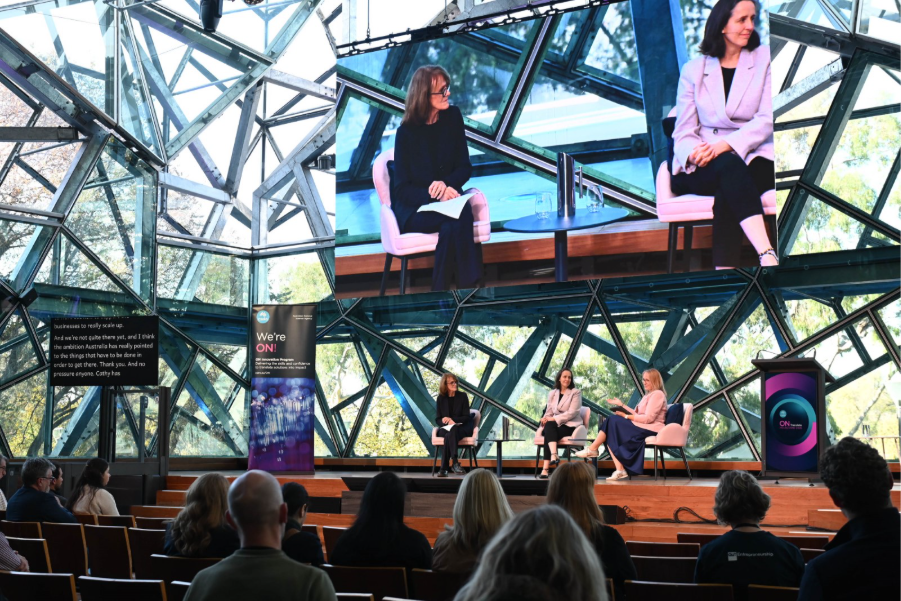
A fireside chat with Cathy Foley ASO PSM and Dr Kate Cornick
Moderator: Tennille Eyre
“There is actually an awful lot of money that flows throughout the broader R&D system in Australia – but it’s spread through over 150 programs in the Federal Government alone. We need focus. How can we reorganise ourselves so that every dollar invested actually makes a difference?” – Dr Kate Cornick
This fireside chat features Cathy Foley ASO PSM, Australia’s Former Chief Scientist and Dr Kate Cornick, Chief Executive Officer of Tech Council of Australia, for a timely conversation on the future of Australia’s R&D and innovation system.
This session explored one of Australia’s most urgent innovation challenges: what needs to change across leadership, policy direction, investment and system coordination to better translate Australia’s research strength into action and impact. It also highlighted the role of the ON Program as a proven model designed to bridge the gap between research ambition into real-world impact.
Watch the session:
Key takeaways:
- There is a plethora of programs that exist in the Federal Government alone. The SERD review was covering between 150 and 190 programs. It’s not that the innovation ecosystem needs more funding from the government, it’s that we need to be more efficient and coordinated with that money.
- Don’t wait for the government to do things. We also have a lot we can empower ourselves to do. Organise ourselves, be coordinated, look at how to grow the sector, rather than fighting with each other. Present to the government with real clarity on what the gaps are that no one else will fund, and what is the pathway forward.
- Due to programs like the ON Program, we’ve seen a real culture change in the research sector – from saying ‘we don’t know how to do this’ to people having a real ambition to commercialise their work. Now we need to figure out how to support those businesses to scale up.
- It’s easy to go to the government and say you’ve got to invest but they have a limit. We need to activate the private sector, and in its first step, that’s angel investors. How do we help those investors get more comfortable investing in deep tech? Then the next stage is to encourage more venture capital into this space.
- We’ve got phenomenal people and phenomenal research ideas; we’ve just got to unlock them. Provide the right supports and networks to help the individuals that make up Australia achieve their full ambition.
Translating Research Together
Panel speakers: Prof Sharath Sriram, James Bradley and Grace Bird
Moderator: Dr David Ireland
Led by David Ireland, this panel brings together perspectives from across research, industry and innovation to explore how Australia can build a more connected and collaborative research translation ecosystem and strengthen the R&D pipeline.
The panel discussed the evolving landscape of research translation in Australia. A central theme was the need for policy reform and stronger incentives to reduce barriers to translation, alongside increased university support through proof-of-concept funding, venture capital and innovation programs.
Featuring Sharath Sriram, Chief Scientist of Western Australia, alongside James Bradley, a two-time deep tech founder and Grace Bird, head of Atmosphere fund at Main Sequence, the conversation explored how stronger cross-sector partnerships, aligned national priorities and more coordinated pathways can help turn research excellence into real-world impact.
Key takeaways:
- There is a critical place for fundamental research and translation should be in addition. Australia sits in the top 1% globally in at least 15 fields of research yet ranks 93rd on the Economic Complexity Index. Translation is how we convert that strength into high-value industries, jobs and sovereign capability.
- Strong translation pathways create deep tech startups and spinouts in areas such as clean energy, space and advanced manufacturing, helping build the next generation of Australian industrial champions.
- Significant gaps remain in early-stage capital and specialised infrastructure. The panel highlighted the need for facilities such as ISO-certified pilot manufacturing environments to help deep tech ventures progress from laboratory research to commercial readiness.
- Researchers do not need to become long-term CEOs to contribute to successful translation. Many can create impact through flexible pathways, including partnering with experienced commercial leaders or transitioning into Chief Technical Officer (CTO), advisory or technical leadership roles.
- Effective translation expands career opportunities for researchers, creating pathways as founder-researchers, research-driven executives and industry collaborators while enabling continued engagement with fundamental science.
- Tech transfer has shifted from blocker to enabler: Tech Transfer Officers (TTOs) are now practical partners, helping with spin-out structures, industry partners and early connections, not just IP policing.
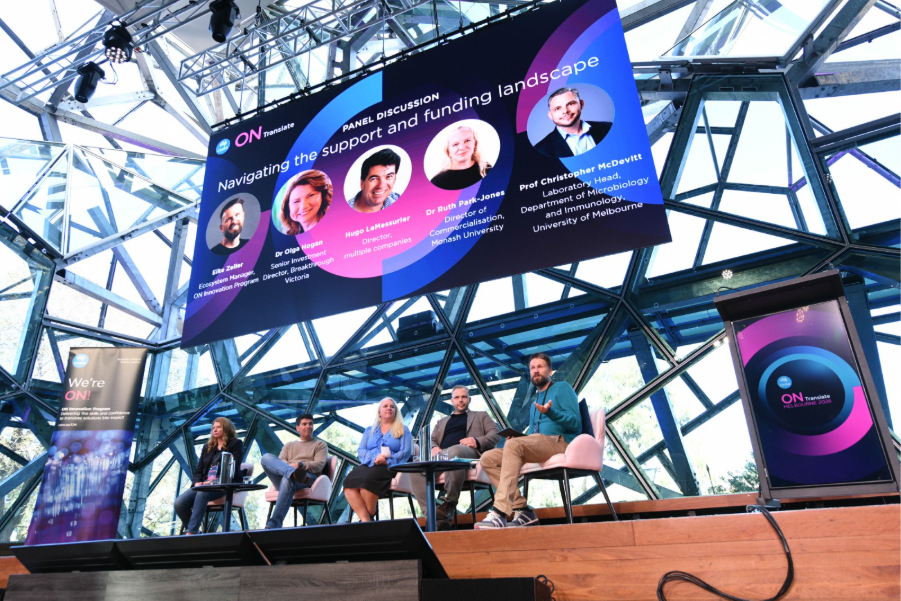
Navigating the Support and Funding Landscape
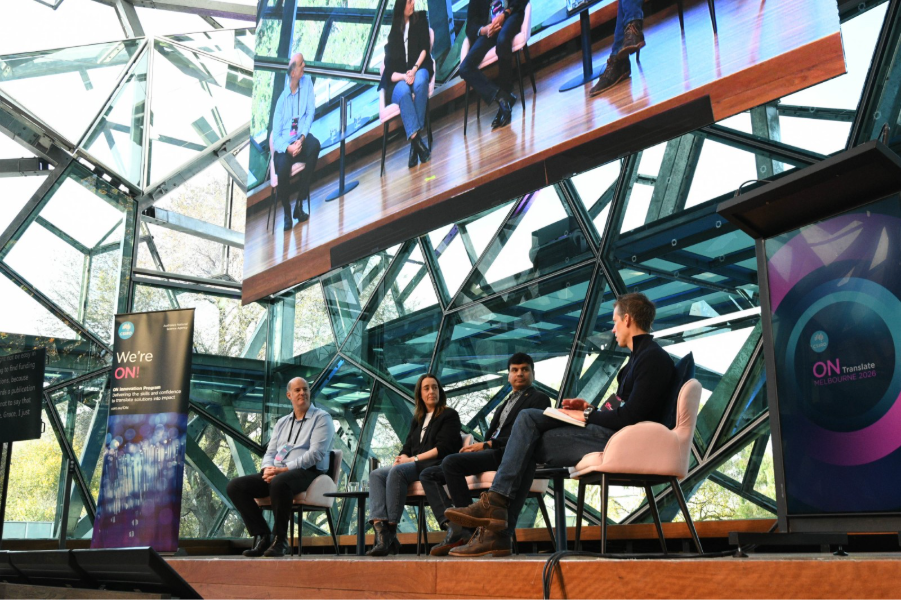
Speaker: Hugo LeMessurier, Dr Olga Hogan, Dr Ruth Park-Jones, Prof Christopher McDevitt
Moderator: Eike Zeller
This session explored the funding, mentoring and support pathways available across Australia’s innovation ecosystem. Moderated by Eike Zeller, the panel included Hugo LeMessurier, Dr Olga Hogan, Dr Ruth Park-Jones and Prof Christopher McDevitt, expert speakers across both industry and research.
This panel explored how deep tech researchers and founders can better navigate funding pathways and commercialisation by integrating non-dilutive grants, private investment and accessing to accelerator program support.
The discussion highlighted the importance of tailoring communication for different investors and building a coherent funding strategy that combines grants, angel investment, venture capital and R&D tax incentives. Non-dilutive funding through translational and industry-aligned grants was positioned not only as a source of capital, but also as valuable external validation of both technology and market potential.
Watch the session:
Key takeaways:
- Commercial viability in deep tech sits at the intersection of technology risk and market risk, where strong science alone is not enough. Being investor-ready requires more than strong science. Clean, commercialisable IP, a motivated founding team and a business plan linked to clear value inflection points are essential.
- Different ventures require different funding pathways. Grants, angel investors, Venture Capital (VC), R&D tax incentives and friends-and-family capital can all play a role, and ventures that are not traditionally VC-backable can still attract significant funding.
- Programs like the ON Program provide valuable opportunities for market discovery, mentorship and developing investor-ready narratives. Maintain ongoing customer and market engagement to refine your value proposition and target market.
- Turning research into impactful ventures requires deliberate capability building, including active participation in the innovation ecosystem and continuously refining how value is communicated to different stakeholders.
- Coachability, commercial mindset and the ability to engage with investors are critical capabilities that accelerators help founders develop. Build an advisory group and learn from previous spin-outs and domain experts to accelerate funding readiness and avoid common pitfalls.
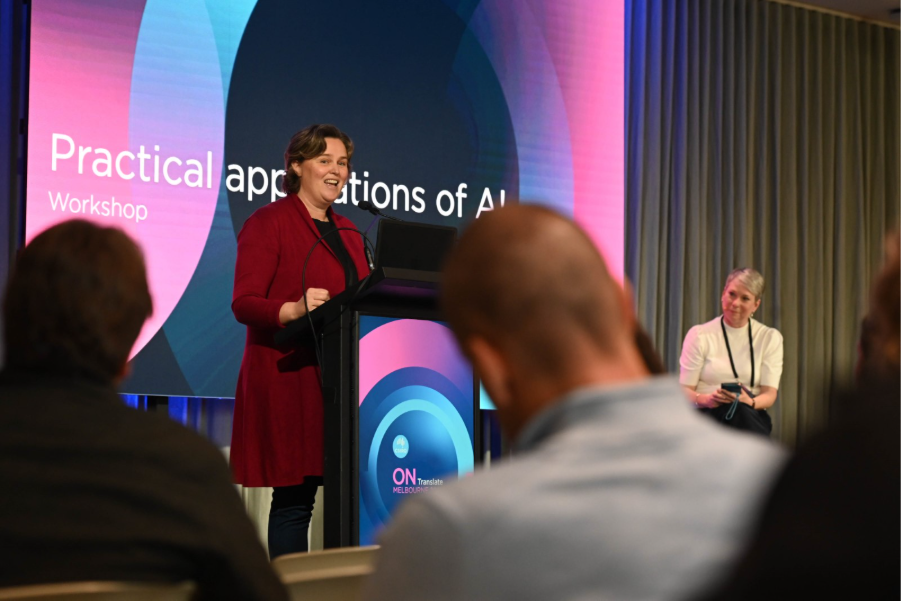
AI Adoption, Integration and Impact: Turning complexity to confident decisions
Facilitators: Anthea Roberts – Dragonfly Thinking and Joanne Jacobs
This session looked at AI beneath the national headlines: into capability, workforce integration, barriers to adoption and value creation. We explored the many competing truths in tension. Moderated by digital strategist, company director and ON Program facilitator Joanne Jacobs, featuring Anthea Roberts, Founder of Dragonfly Thinking, this session brought together expert perspectives and practical examples to explore the role AI can play in translating knowledge into impact.
It featured a live demonstration of Dragonfly Thinking’s AI-powered platform, showcasing how expert-informed, multi-perspective analysis can help decision-makers navigate complexity, test their assumptions and make more confident decisions.
Key takeaways:
- Australia is world-class in AI capability and research talent, yet it sits lowest in public trust and lags its peers in enterprise deployment.
- Until now, we wanted to hire T-shaped professionals – those with both breadth and depth in expertise and skills. Now, combined with AI fluency, these professionals can compound their value, visualised in a diamond shape.
- People tend to love or hate AI based on where they sit in the “0→1, 1→10, 10→100” spectrum: it feels exciting when it unlocks new capabilities or enables reinvention, but frustrating in the middle. In the middle, it often adds extra work, makes hard-earned skills feel less unique, and leaves you caught between beginners catching up and advanced users pulling far ahead.
- Anthea encouraged the audience to move from chat-based tools to agentic AI which has greater capabilities for complex workflows, decision making, and multi-step, dynamic processes.
- As we move into the near future, it will become commonplace for researchers and businesses to hold multiple, paid AI subscriptions, especially for tasks like coding.
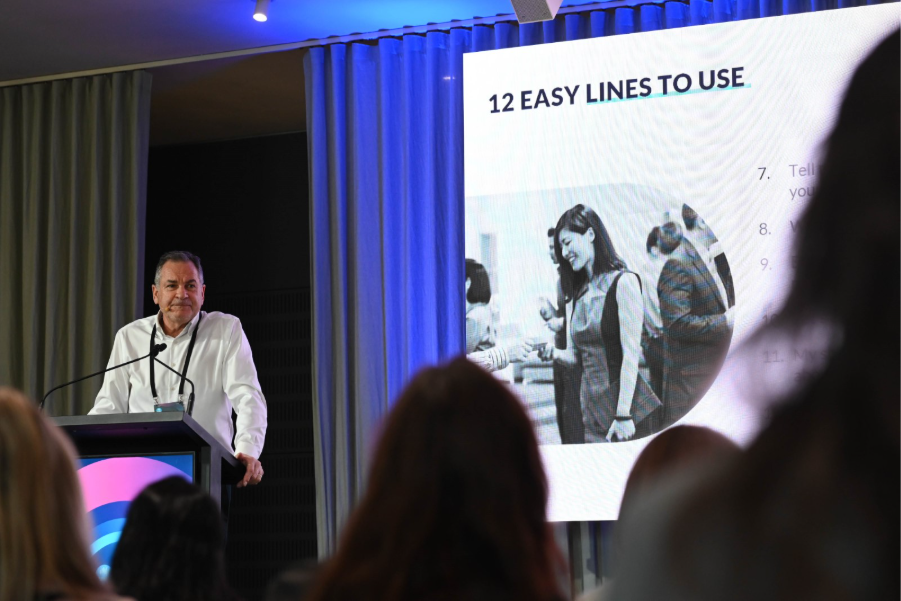
5 Really Easy Ways to Network (Even If You’d Rather Not!)
Speaker: Laurie Serafini
If the thought of networking makes you want to disappear into the nearest corner, you’re not alone. For many researchers, starting conversations with strangers can feel awkward, forced or completely unnatural. But meaningful professional connections don’t have to come from “working the room” or pretending to be someone you’re not.
This engaging and highly practical workshop shared 5 simple techniques to start conversations more naturally, navigate them with confidence, and leave a lasting impression; without the small-talk exhaustion. It was hosted by Laurie Serafini, a high-level communication and business coach.
Key takeaways:
- Keep up the with the news and you will always have an easy, relevant conversation topic to talk to.
- Be curious. Aim to listen more than be listened to.
- Focus on building relationships, not collecting contacts.
- The first few seconds are critical, that is where people make their first impression.
- Be mindful of things like body language. A smile is contagious.
- Make eye contact when introducing yourself and hold eye contact for a second longer when listening.
- Be comfortable with short pauses.
- It’s ok to end a conversation, just say “it was nice to meet you” and move on to the next conversation.
- Practice – don’t shy away from networking events, use them as an opportunity to get more comfortable with it.
- Follow up – nurture relationships once made, don’t be shy to follow up, ask to get coffee, etc.
ON Accelerate 10 Pitch Showcase
Time: 3:15 PM – 5 PM Venue: The Edge
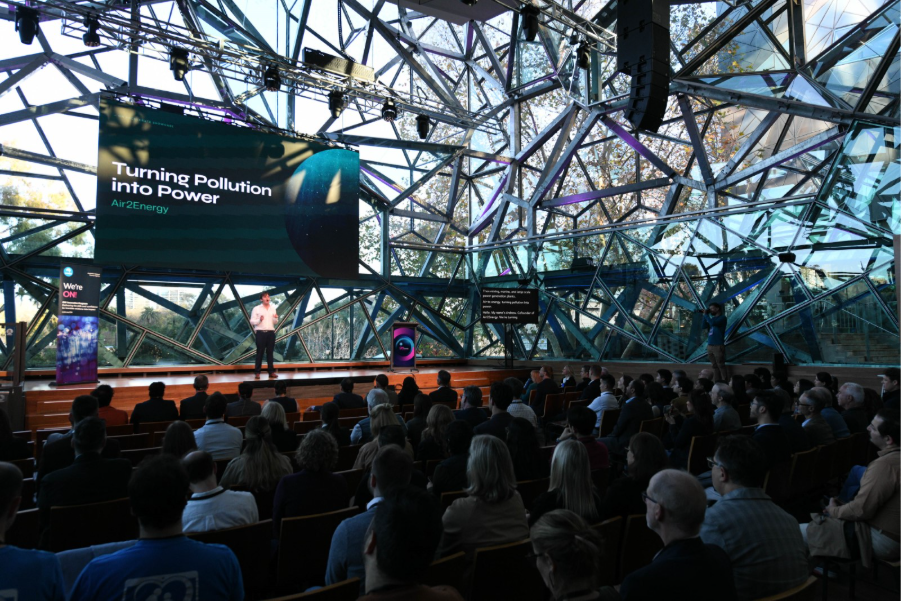
10 teams from our ON Accelerate 10 cohort presented their deep tech ventures on stage at ON Translate 2026. Developed from Australian research and designed to transform industries, these teams are tackling big challenges and showed us what it means to translate research into real-world impact.